
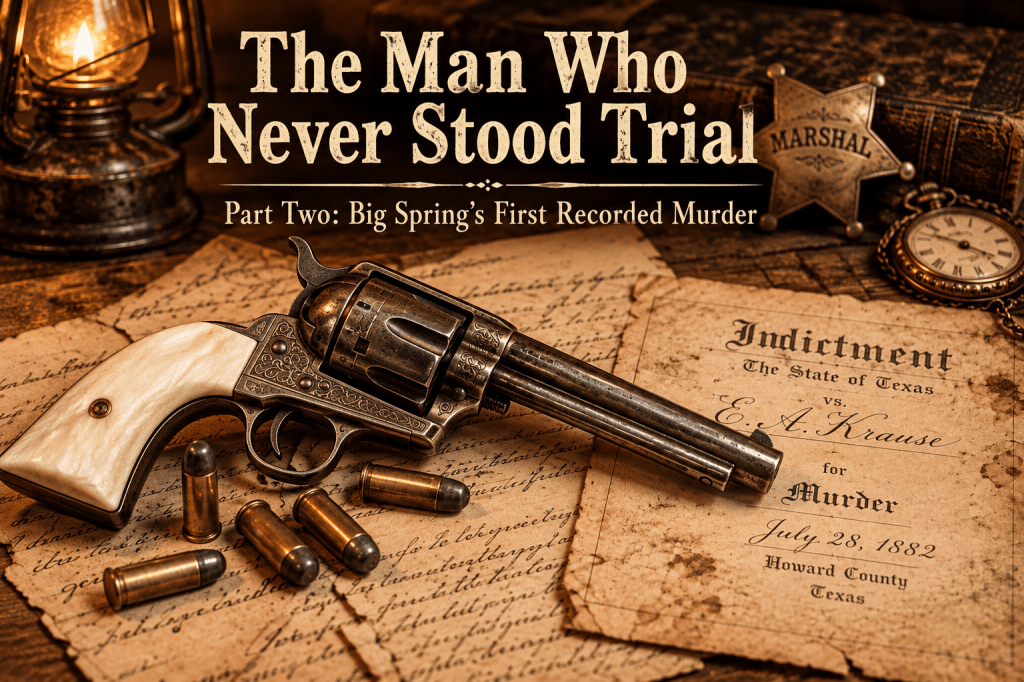
Now, we turn our attention to E. A. Krause, the man accused of murdering Payne Holt in July 1882.
The surviving court records reveal that Krause was formally indicted for murder by a Howard County grand jury. The indictment describes the events of July 28, 1882, alleging that Krause struck Holt repeatedly in the head, inflicting the wounds that caused his death. According to the indictment, the pistol itself was used as a weapon.
Following his arrest, Krause secured his release on a $5,000 bond with the involvement of the 30th District Judge, Thomas Lewis Nugent. The bond, executed on September 13, 1882, was backed by eleven individuals who agreed to serve as sureties, assuming financial responsibility for Krause’s appearance in court.
Those eleven individuals were:
- Joe Collins
- J. H. Shaughnessy
- Melissa Shaughnessy
- T. P. Stevens
- J. B. Brown
- J. H. Good
- Harry Herschen
- O. J. Wiren
- C. M. Mann
- J. M. Aston
- J. H. Chesben
Research into the eleven individuals who signed Krause’s bond led to a previously overlooked detail about the accused murderer. E. A. Krause had been elected City Marshal of Colorado City, Texas, in April 1882, just three months before Payne Holt’s death. The position of city marshal was comparable to that of a modern-day police chief.
According to an article titled “Chief Lone Wolf,” published in the Colorado City Record on October 31, 1991, Krause was Colorado City’s first city marshal. The article reports that on April 19, 1882, the town council established his salary at $75 per month. His tenure was brief, and George W. Anderson succeeded him on August 1, 1882. Wonder why?
The discovery adds an extraordinary dimension to the case. A man entrusted with upholding the law in a neighboring frontier town would, within months, find himself accused of murder in Howard County.
Krause’s position as marshal also raises questions about his standing in the community and the relationships that may have helped him secure eleven individuals willing to guarantee his $5,000 bond.
Under the terms of the bond, Krause was required to appear before the District Court of Howard County and remain subject to its proceedings until his case was resolved.
But when October 10, 1883, arrived, Krause failed to appear.
The man accused of Big Spring’s first recorded murder had seemingly vanished, leaving eleven sureties and a $5,000 bond behind.
Despite the seriousness of the charge against him, the surviving court records examined thus far provide no evidence that Krause ever stood trial or was punished for Holt’s death. What became of Krause remains unknown.
Yet another mystery remains within the surviving court documents. Among the papers copied from the Krause murder file is a handwritten jury finding, apparently from a separate proceeding, stating, “We the jury find for the defendant.” The document bears what appears to be a different case number and includes wording suggesting additional defendants.
Could this proceeding have involved the eleven individuals who guaranteed Krause’s $5,000 bond? Was it part of an effort to recover the money after he failed to appear? Or was it an unrelated proceeding preserved among the murder records?
The answers remain unknown. Perhaps a future historian, following the same paper trail, will discover what became of Krause and why this curious document was included among the records of Payne Holt’s murder.
Payne Holt was originally laid to rest in what is known as Big Spring’s Lost Cemetery, located just north of the railroad tracks. In March 1883, his brother came to Big Spring to claim his remains and move him closer to the family homestead.
Today, Payne Holt rests in the cemetery at Dido, Texas, alongside his mother, Louisa, who died three years after her son.
His headstone bears a simple inscription:
M. P. Holt
1853–1882
MAY HE REST IN PEACE
More than 140 years have passed since Payne Holt lost his life in the rough and uncertain days of frontier Big Spring. Although the circumstances surrounding his death survive in the court records, the ultimate fate of the man accused of killing him remains uncertain.
Now that his story has been told, I hope he does rest in peace.
Beth Henry, aka Beth of Death
Read Part One: The Killing at the Nip & Tuck Saloon
Historical and Archival Sources
Howard County District Court, Case No. 2, State of Texas v. E. A. Krause (1882–1883). Copies of handwritten court records, including the grand jury indictment, September 13, 1882 bond, and related court proceedings.
“Chief Lone Wolf,” Colorado City Record, October 31, 1991, p. 6. Historical newspaper account identifying E. A. Krause as Colorado City’s first city marshal, describing the April 19, 1882 salary authorization and the appointment of his successor.
Additional court document: Handwritten jury finding preserved among the copied Krause case materials, apparently designated Case No. 14. Its relationship to the murder prosecution has not been established.
Explore the Archival Records
To examine the court documents, newspaper accounts, and other historical records used in researching this story, visit Payne Holt Murder: Documents & Discoveries.



Leave a Reply