
Truth or a Tall Texas Tale?
What follows is a page from Big Spring history. How true it is, I will leave to you, the reader.
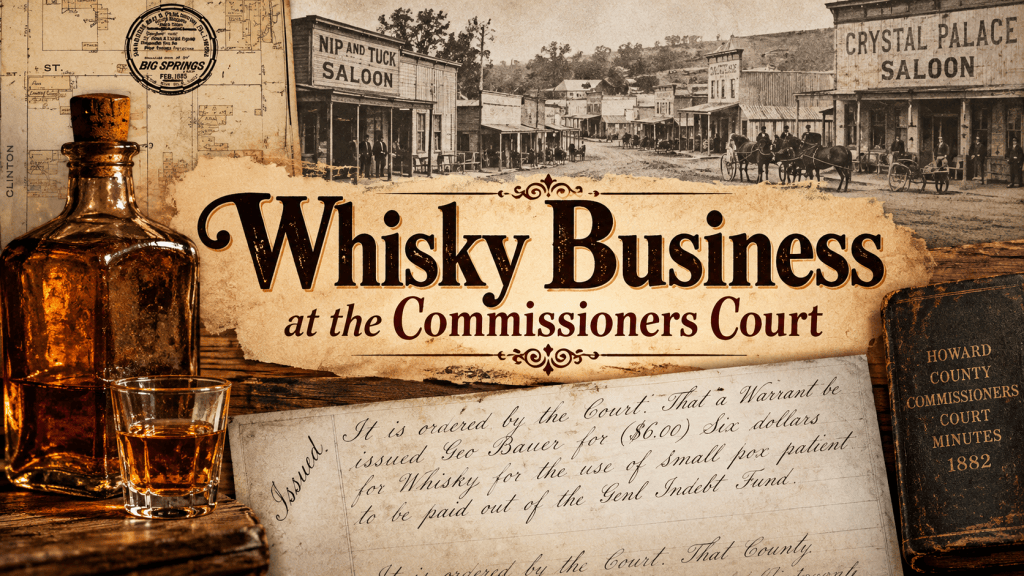
In the early days of Big Spring, the town had all the makings of a Wild West frontier community. An 1885 Sanborn fire insurance map shows nine saloons within a three-block area, by my count, although local legend puts the number at thirteen. Stories traveled quickly in a place like that, and over time, fact and folklore often became difficult to separate.
Howard County’s Commissioners Court began conducting county business in 1882. Its early minutes offer a glimpse into the everyday concerns of a newly organized county. The entries are generally brief, recording expenditures and decisions with little explanation.
One such entry, dated November 13, 1882, authorizes a six-dollar warrant for whisky intended for a smallpox patient.
It is a small detail, easily overlooked. But somewhere along the way, that ordinary county expenditure became the subject of a rather entertaining story.
According to a later account, the whisky never reached the patient. Instead, members of the Commissioners Court supposedly consumed it themselves while conducting county business at the Crystal Palace Saloon.
It’s certainly the sort of story one might expect from an early West Texas town. But does the historical record support it?
Joe Pickle references the story in his book Gettin’ Started: Howard County’s First 25 Years, citing an account published in a special section of the Big Spring Herald on March 27, 1908. Despite extensive searching, I have been unable to locate a physical or digital copy of that particular edition.
That led me to the Howard County Clerk’s Office, where I examined the original handwritten Commissioners Court minutes.
The November 13, 1882, minutes identify the meeting place as “Townhall.” They do not mention the Crystal Palace Saloon. Although the precise location of Townhall remains uncertain, it is the location actually recorded by the commissioners.
There is another detail that makes the story especially interesting.
The whisky warrant names George Bauer, who was associated with the Nip and Tuck Saloon. The Crystal Palace Saloon, however, was operated by J. M. Walker, whose newspaper advertisement identifies him as its proprietor.
Two different men. Two different saloons.
That distinction matters because the later story places the commissioners at Walker’s Crystal Palace, while the documented whisky expenditure names Bauer.
An additional curiosity appears in a later historical account published by the Big Spring Herald. It describes Bauer’s Nip and Tuck as a saloon that sold only beer, with beer kegs kept on ice and customers paying a nickel for a drink.
If that description accurately reflects the saloon’s business in 1882, it raises another question: Why was Bauer supplying whisky to the county? Of course, operating a beer-only saloon would not necessarily have prevented him from obtaining whisky for another purpose. The records do not explain the arrangement.
And just how much whisky would six dollars have purchased?
Historical accounts of frontier liquor prices vary considerably. Depending on quality and location, a bottle of whisky might have cost approximately one to three dollars. Individual drinks were sometimes priced at twenty-five cents, although cheaper establishments charged less.
By those broad estimates, six dollars could have purchased several bottles. But the Commissioners Court minutes do not specify the quantity, bottle size, or price per unit. We cannot know precisely how much whisky Bauer provided.
The expenditure also needs to be considered in the context of nineteenth-century medical practices. Alcohol was sometimes used medicinally, including as a stimulant for seriously ill patients. Its appearance among county expenses is therefore not, by itself, evidence of anything improper.
The same page of the minutes records other expenses associated with smallpox patients, including groceries and buggy hire. Together, these entries offer a glimpse into the county’s efforts to provide for the sick, although the minutes tell us little about the circumstances.
So where does that leave our story?
The surviving minutes document a six-dollar warrant payable to George Bauer for whisky intended for a smallpox patient. The court records identify Townhall as the meeting place.
They do not establish that the commissioners met at the Crystal Palace Saloon or that they consumed the whisky themselves.
Perhaps the story grew out of a misunderstanding. Perhaps it was embellished over the years, as frontier stories so often were. Or perhaps some detail has been lost that would explain how the Crystal Palace became part of the telling.
For now, the records give us one account, while local stories offer another.
Truth or a tall Texas tale?
I’ll leave that judgment to you.
Historical Sources and Notes
- Howard County Commissioners Court Minutes, November 13, 1882. Original handwritten county minutes examined at the Howard County Clerk’s Office, Big Spring, Texas. The reproduced archival image is a digitally adjusted photograph of a copy of the historical record.
- Joe Pickle, Gettin’ Started: Howard County’s First 25 Years. References an account attributed to the Big Spring Herald, March 27, 1908. The newspaper issue has not yet been independently examined.
- J. M. Walker, Crystal Palace Saloon advertisement. Historical newspaper advertisement identifying Walker as proprietor. Newspaper title and date remain to be established.
- Big Spring Herald, October 31, 2022. Later historical account describing the Nip and Tuck as a beer-only saloon.
- 1885 Sanborn fire insurance map, Big Spring, Texas. Nine saloons identified within a three-block area by the author.
- Historical liquor prices: General frontier-era estimates for context, not verified Big Spring prices.
Beth Henry, aka Beth of Death



Leave a Reply