
Part One: The Killing at the Nip & Tuck Saloon
Howard County District Court Case #2
Big Spring’s past is full of stories, but this one still has a missing piece.
HCDC #2 | Big Spring, Texas | July 28, 1882
It began on the night of July 28, 1882, sometime between ten and eleven o’clock, at George Bauer’s Nip & Tuck Saloon. By the following morning, a 28-year-old man named Payne Holt would be dead, and another man, E. A. Krause, would find himself accused of murder.
What makes this story particularly interesting is that we don’t have to rely entirely on newspaper accounts or stories passed down through generations.
We have the court records.
And the witnesses had quite a bit to say.
Exhibit A: A Game of Pool
According to J. P. Hogan, one of the principal witnesses, Payne Holt entered the Nip & Tuck Saloon that evening “pretty full.”
Payne Holt asked J.P. Hogan to play a game of pool. Hogan agreed, later explaining that he hoped to keep Holt occupied and prevent him from drinking any more.
During the game, E. A. Krause joined them and ultimately won.
It seems an ordinary enough beginning. Three men, a pool table, and a saloon in a young railroad town.
But the game did not end peacefully.
According to the testimony, Krause began taunting Holt over the loss. Holt was apparently none too pleased with Krause’s involvement in the game.
J.P. Hogan recalled Payne Holt shouting:
“Dog on your skin, we didn’t ask you in the game.”
Whatever else was said, the disagreement did not remain at the pool table.
It moved outside.
Exhibit B: The Confrontation
John Monahan, who was among those inside the saloon, later reported hearing the argument escalate.
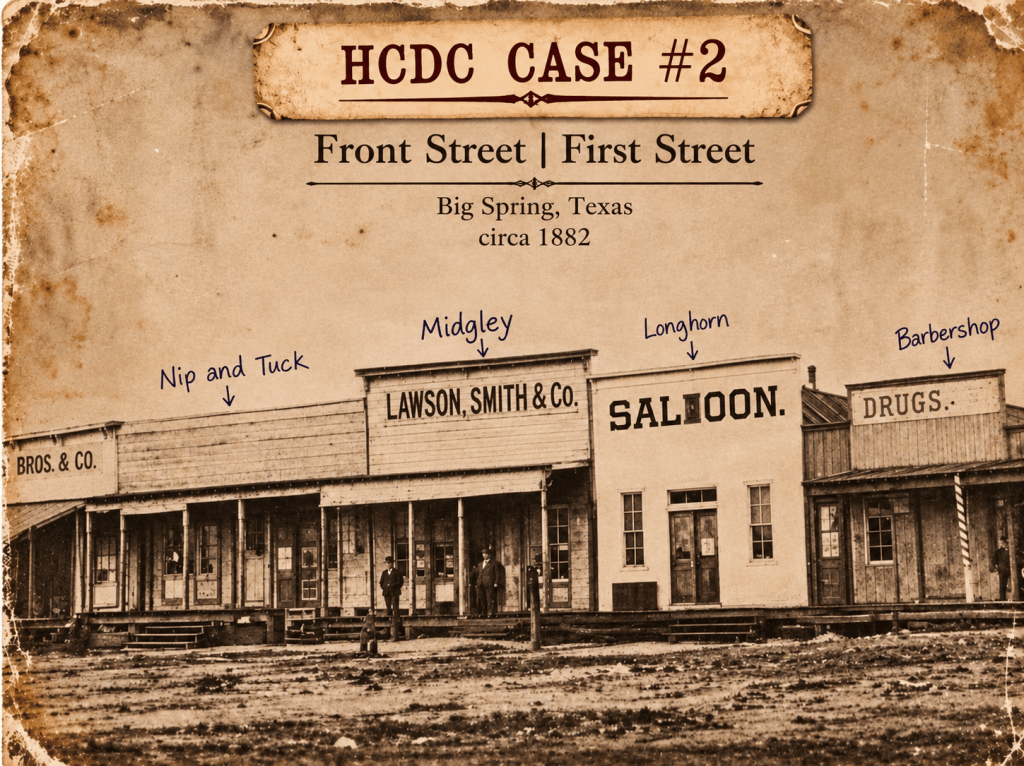
Another witness, A. W. Midgley, was sitting in front of Lawson, Smith & Co. that evening. His testimony provides a particularly revealing account of what happened.
It was between 10 and 11 o’clock at night, and the light outside the Nip and Tuck Saloon was not burning. With visibility poor, Midgley moved closer to get a better view of the confrontation.
He described Krause as sober but excited, while Holt appeared to be trying to withdraw from the encounter rather than provoke it. Midgley also described the men facing toward the nearby barbershop, helping us place their movements along Front Street.
Although Midgley observed the knife in Payne’s hand, he could not determine whether its blade was open or closed. Other testimony, however, described the knife as unopened.
That detail matters, because the presence of a knife could change how someone understood the confrontation.
But having a knife and threatening someone with it are not necessarily the same thing.
The testimony also describes Krause carrying a revolver.
What followed was not a gunfight of the sort we associate with the Old West.
No shot was fired.
Instead, Payne Holt received two blows to his left temple. According to the account preserved in the case, one came from Krause’s fist and the other from the butt of his pistol.
A six-shooter could be deadly without ever firing a bullet.
Payne Holt was seriously injured.
And what might have appeared to some witnesses as another saloon fight was about to become something far more consequential.
Exhibit C: The Doctor’s Findings
By 9:30am the following morning, July 29, 1882, Payne Holt was dead.
Dr. McHenry examined him and documented the injury to his left temple. According to the medical findings preserved in the case, the wound extended to the skull.
The doctor attributed Payne Holt’s death to the injury to his temple and reported no evidence of apoplexy caused by drinking.
That distinction is important.
Several witnesses described Payne Holt as intoxicated. But the doctor’s findings identified the head injury, not intoxication, as the cause of death.
The testimony tells us about the argument.
The medical examination tells us what killed Payne Holt.
Together, they form the foundation of Howard County District Court Case #2.
Exhibit D: A Murder Charge
Court records reveal that a commitment for E. A. Krause was issued by I. D. Eddins, Justice of the Peace for Precinct No. 1 in Howard County, dated July 28, 1882, the very night of the altercation at the Nip & Tuck Saloon. In a sworn statement dated August 11, the Mitchell County sheriff confirmed that Krause had been detained under that commitment.
While in custody, E. A. Krause challenged the legality of his detention. In a petition for a writ of habeas corpus, he argued that he was being unlawfully held under a warrant issued by Justice of the Peace I. D. Eddins.
His petition reached T. L. Nugent, judge of the 30th Judicial District. On August 4, 1882, Nugent acknowledged that Judge T. B. Wheeler of the 12th Judicial District was absent from the state and ordered the Mitchell County sheriff to bring Krause before him in Stephenville on August 14. Nugent ordered that Krause be released upon posting a $5,000 bond, a substantial obligation in 1882.
What began as a violent confrontation in a Big Spring saloon had now become a legal dispute extending well beyond Howard County.The case would soon become more complicated.
But that is where the next part of this investigation begins.
Because although the records tell us what happened to Payne Holt, they raise another question about the man accused of killing him.
Beth Henry, aka Beth of Death
To Be Continued
Big Spring’s First Recorded Murder: Part Two→
In the next installment, we’ll follow Krause through the courts, examine the unusual circumstances surrounding his release, and discover what happened when he was expected to appear before a judge.
From the Archives
The Payne Holt investigation is based on historical court records, witness testimony, medical findings, and contemporary newspaper accounts.
Copies of the surviving court documents from Howard County District Court Case #2 are available in the companion article.
Research and story by Beth Henry, aka Beth of Death.
Dust and the Dearly Departed: The History and People of Early Big Spring, Texas.



Leave a Reply