
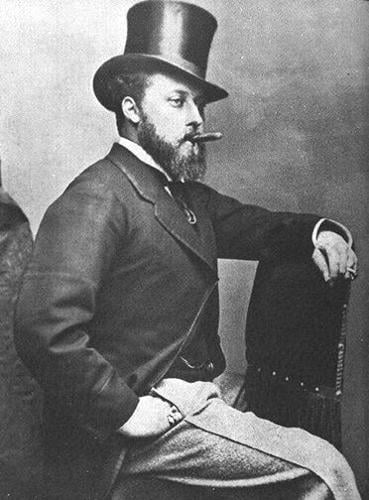
New to the Earl’s story? Begin with Part One: The Earl
I’m a visual learner, and somewhere in all the newspaper articles, dates, names, and railroad connections, it’s easy to get tangled up in the tracks.
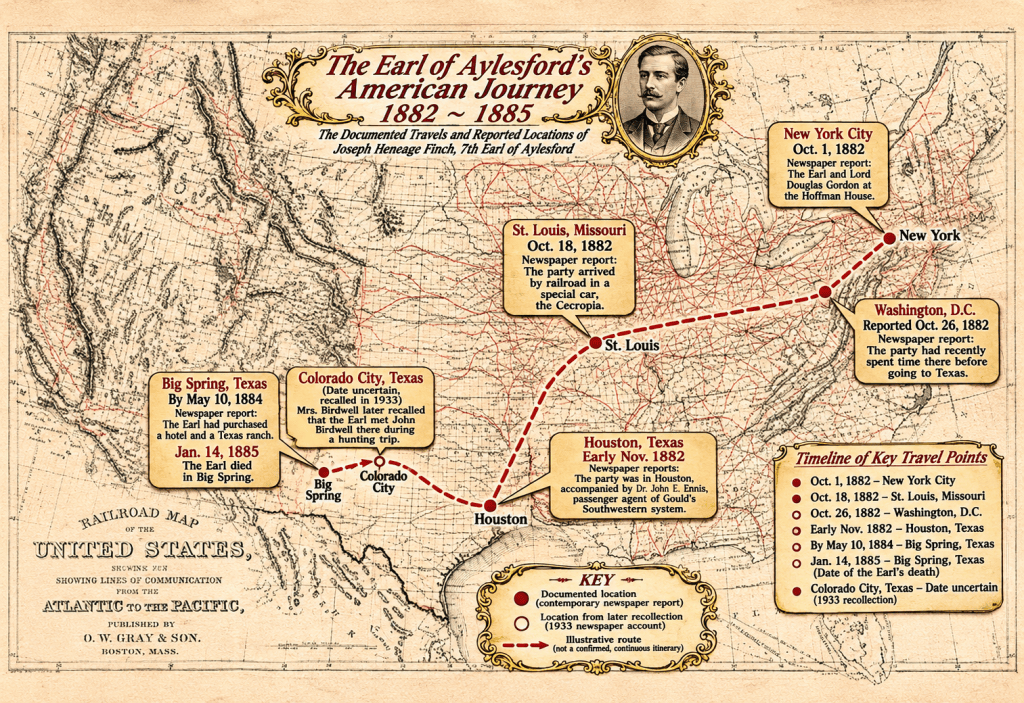
I created the map below to make it easier to follow the Earl of Aylesford’s travels across America and eventually to Big Spring, Texas. The dates on the map come from newspaper reports, which don’t always establish the exact dates. Still, they give us a pretty good idea of where he went and when.
There’s been a great deal written about the Earl’s time in Big Spring, and I have no desire to retrace someone else’s research. What interests me is the journey that brought him here. How did an English nobleman, who had spent much of his life among royalty and aristocracy, find a path to a little railroad town in West Texas?
Along the way, he would meet a man named John Birdwell, who, according to local accounts, gave him a nickname that stuck with him for the rest of his life: the Judge.
An English Earl in New York
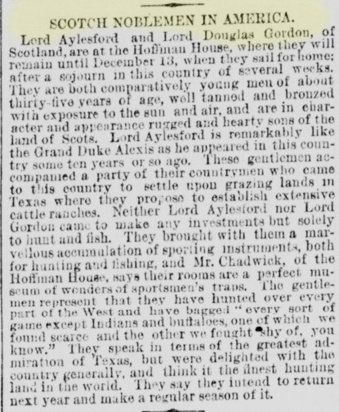
On October 1, 1882, the New York Times reported the Earl of Aylesford and Lord Douglas Gordon were staying at the Hoffman House in New York City.
The Hoffman House was a fashionable hotel, and the Earl was certainly accustomed to fashionable surroundings. But whatever comforts New York had to offer, he apparently had something considerably more adventurous in mind.
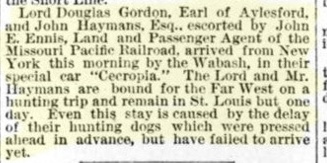
On October 18, the St. Louis Post-Dispatch reported that Lord Douglas Gordon, the Earl of Aylesford, and John Hargreaves had arrived from New York aboard the Wabash Railroad in a special car named Cecropia. They were accompanied by John E. Ennis, a land and passenger agent of the Missouri Pacific Railroad.
The newspaper also included a rather amusing detail. Their stay in St. Louis had been delayed because their hunting dogs, sent ahead of them, hadn’t arrived.
Apparently, even English nobility couldn’t always keep their travel plans on schedule.
Following the Railroad Tracks
The October 26, 1882 Elgin Daily News, reported that the Earl’s party had spent some time in Washington, D.C., before leaving for Texas to hunt. The report doesn’t establish the exact dates of their Washington visit.
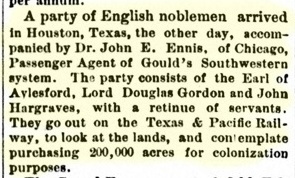
By early November, newspapers were reporting the party in Houston. The November 4, 1882, Milan Exchange and November 8 Batesville Guard identified the Earl, Lord Douglas Gordon, and John Hargreaves were traveling with Dr. John E. Ennis, a passenger agent of Jay Gould’s Southwestern railroad system.
According to those reports, the party intended to travel on the Texas & Pacific Railway to examine land, with the possibility of purchasing as much as 200,000 acres for colonization.
This is where the story gets interesting. The Texas & Pacific was the railroad that ran through Big Spring.
Here we have a contemporary newspaper report placing the Earl’s intended travels along the very railroad that connected our town to the rest of the country.
It doesn’t prove that he stopped in Big Spring during that journey, but it certainly gives us a reason to look more closely.
It also raises another question: Was this simply a hunting expedition, or was there already some interest in purchasing land?
The newspapers suggest that both possibilities were being discussed.
The Jay Gould Connection
John E. Ennis is an interesting figure in this story.
He wasn’t simply another gentleman accompanying the Earl on a hunting expedition. Newspapers identified him as a railroad land and passenger agent.
Jay Gould controlled an extensive railroad network during this period, including the Missouri Pacific and interests connected with the Texas & Pacific.
Railroads had a considerable interest in attracting investors and settlers to the territories they served. A wealthy Englishman considering large land purchases would certainly have been a desirable passenger.
The Earl’s association with Ennis gives us a documented connection to Gould’s railroad interests.
What I haven’t established is whether the Earl and Jay Gould personally knew one another or whether Gould himself encouraged the trip. Those are details that will require additional evidence.
For now, Ennis provides a much firmer connection than the stories that have been repeated about Gould’s personal involvement.
Enter John Birdwell
Eventually, our trail brings us to Colorado City, Texas, and a man named John Birdwell.
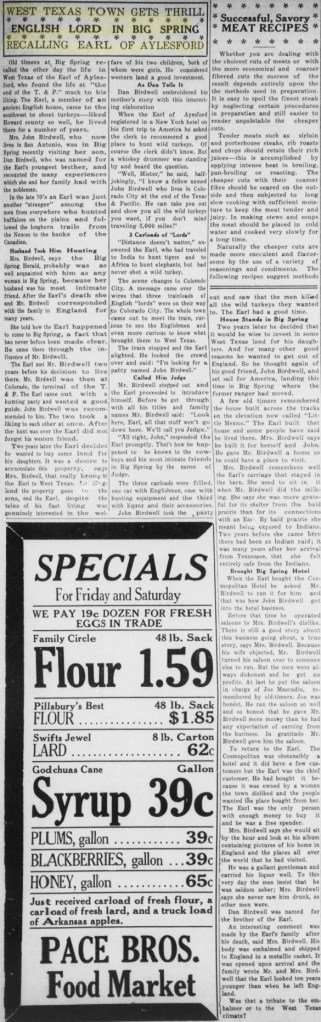
A particularly interesting account appeared in the September 14, 1933, edition of the Nolan County News.
The article recalled that the Earl had met Birdwell during an earlier hunting expedition, when Colorado City was the western terminus of the Texas & Pacific Railroad.
According to Mrs. Birdwell’s account, the Earl’s hunting party needed a good guide, and Birdwell was recommended. The two men apparently took an immediate liking to one another.
When the hunt ended, the Earl remembered his new friend in West Texas.
The article goes on to say that two years later, the Earl decided he wanted to purchase land for his daughters. Mrs. Birdwell recalled that this desire to accumulate property was what ultimately brought him back to West Texas.
What interests me is how hunting and the possibility of purchasing land seem to have become intertwined. The contemporary newspaper reports suggest both were already being discussed in 1882.
Of course, the account was published many years after the events it describes, so I want to be careful about assigning an exact year to that first meeting. The contemporary newspapers establish the Earl’s Texas expedition in 1882, while the Birdwell recollection suggests an earlier acquaintance. Whether those accounts describe the same journey or separate visits remains an open question.
From Hunting Grounds to Landowner
By 1884, the Earl’s interest in Texas had become something more substantial.
The May 10, 1884, issue of Harper’s Bazaar reported that he had paid $75,000 for a Texas ranch and had purchased a hotel in Big Spring.
Another report, published in The Independent on December 4, 1884, stated that the Earl already owned 25,000 acres in Texas. It also mentioned that he had recently sold his English estate for £800,000.
These were considerable figures, although the reports don’t tell us precisely which properties were involved.
The Earl’s purchases would eventually leave a complicated paper trail, one that continued long after his death.
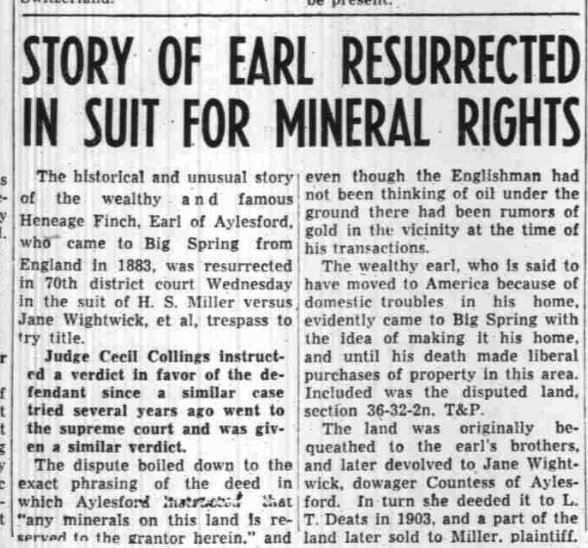
In fact, decades later, a dispute over mineral rights would bring his name back into a Texas courtroom. A newspaper account of the case, H. S. Miller versus Jane Wightwick and others, described land originally associated with the Earl, its passage through his family, and the question of whether mineral rights had been reserved in the original conveyance.
That later lawsuit is another reminder that the Earl’s brief time in West Texas left a much longer legal and historical footprint.
The Road to Big Spring
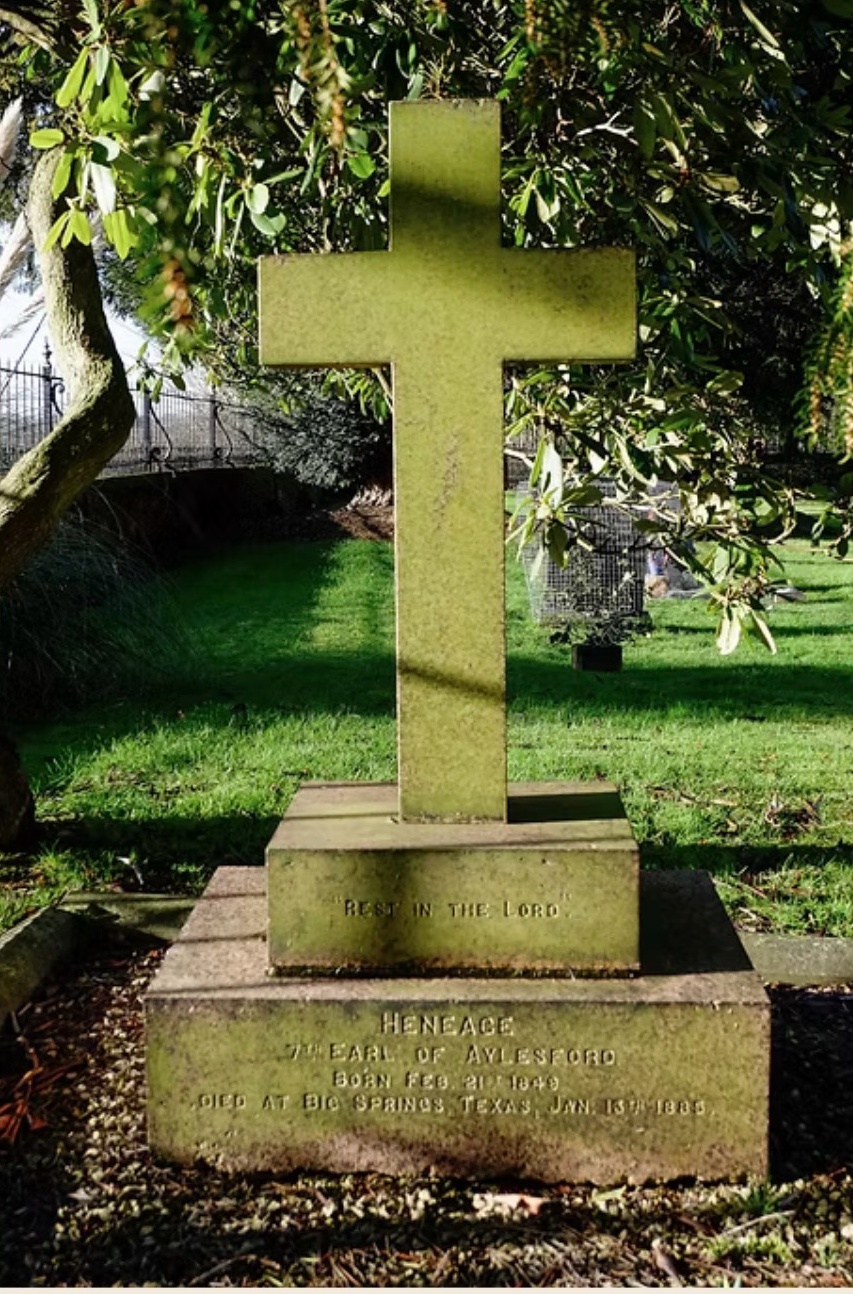
By the time the Earl died in Big Spring on January 14, 1885, he had become part of the history of a town that was still very young.
There is much more to tell about his life here, his friendship with John Birdwell, his business interests, and the circumstances surrounding his death.
The newspaper accounts have given us names, dates, hotels, railroad connections, and even a delayed shipment of hunting dogs. They’ve also helped separate some of the things we know from the things that have simply been repeated over the years.
There are still gaps, particularly concerning the Earl’s earliest Texas visit and exactly when he first met Birdwell.
Every surviving newspaper clipping and courthouse record gives us another opportunity to understand how an English Earl found his way to Big Spring.
And sometimes, following the railroad tracks is the best place to begin.
Beth Henry, aka Beth of Death



Leave a Reply