
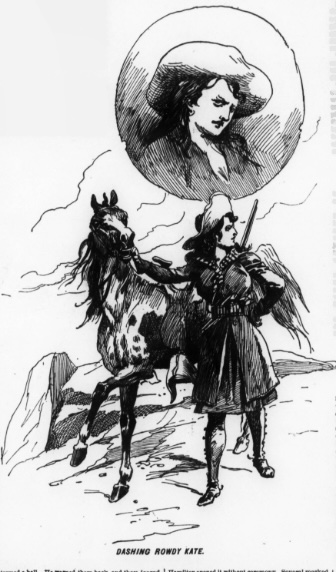
Did a Notorious Women of the Old West Make Her Home in Big Spring?
In 1886, the name Kate Lowe appears in Big Spring tax records. By the time it is all said and done, that name will show up in newspapers, courtrooms, and in the kinds of places good Victorian folks didn’t talk about openly.
Big Spring’s Kate Lowe may have been the same woman known throughout the Old West as “Rowdy Kate”. Stories of her earlier life includes an association with the notorious Rowdy Joe Lowe. I’ll be the first to admit I love that possibility. But I wanted something more than a tale that had been repeated over the years.
Luckily, some things did turn up.
In the June 22, 1886, edition of The Galveston Daily News, a woman in Big Spring is referred to as “Rowdy Kate.” Just three days later, the El Paso Times reported a shooting at a Big Spring house of ill fame operated by a woman known by that same nickname.
The El Paso Times identified John McManus as the man who was shot in the head and arm by the proprietress. McManus reportedly retaliated by throwing beer bottles, severely injuring another woman named Pearl Reilly. He then left town, and the extent of his injuries was unknown.
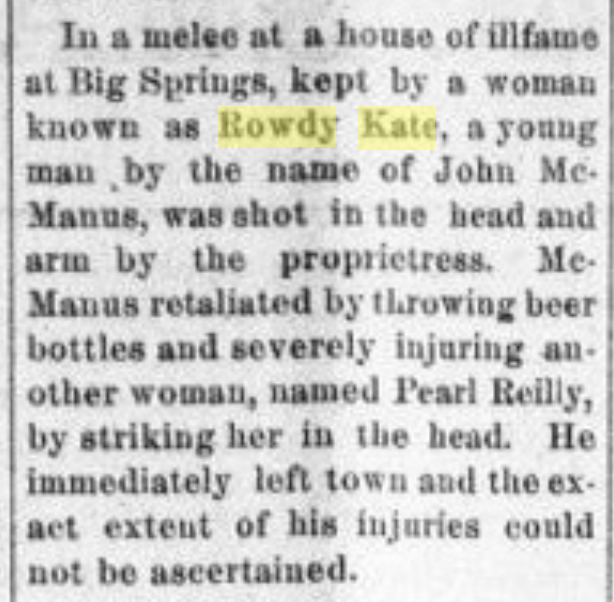
The article doesn’t soften anything. It calls the place what it was, a house of ill fame. It names Kate Lowe as the woman who kept it. Her place of business was known.
A few years later, the courts say much the same thing in more formal language. By the mid-1890s, Kate Lowe is charged with keeping a “disorderly house.” The case is appealed, and the judgment is affirmed.
We are talking about a time when Big Spring was a railroad town. The Texas & Pacific line ran through it, bringing a steady flow of men, money, and sometimes violence. Where you had that kind of traffic, you also had saloons and houses like Kate’s. They were part of the town.
In 1895, a woman known as Rowdy Kate Lowe was accidentally shot in a boomer camp in Purcell, Oklahoma Territory. In Big Spring in April 1896, Kate Lowe appears in the Howard County records as deceased and intestate, meaning she died without a will. John D. Birdwell was appointed administrator of her estate. That is an interesting correlation.
As with many things in that time frame, there are still gaps. We don’t know her origin story or how she ended up in Big Spring. What we do have are the moments where her life crossed into this town’s record. But it didn’t end there.
Among the surviving court records is a rather interesting document involving a man named Will Lowe, who appeared through his attorney claiming to be Kate Lowe’s adopted heir. He protested the payment of several claims against her estate that had been approved by the administrator.
It’s a small detail, but one I haven’t encountered in other accounts of Rowdy Kate’s life. Beyond this appearance in the Howard County proceedings, I have found nothing further about Will Lowe.
The estate proceedings continued for years. Property was sold, debts were settled, and when it was finally done, by October 1900, with the court closing the estate in February 1901, all that remained was twelve dollars and five cents.
The following properties were tied to Kate Lowe’s name in the records:
- Lots 1–6, Block 16
- Lots 7 and 8, Block 16
- Lot 11, Block 16
- Lot 3, Block 99
In my search of newspapers from this period, I have found no mention of a woman known as “Rowdy Kate” living elsewhere around 1885 and 1886. Of course, a lack of evidence is not proof, but when the name begins appearing in Big Spring during those same years, I find the coincidence compelling.
What I do know is that a Kate Lowe lived here, owned property here, and left behind a paper trail that continued long after her death.
Could Kate Lowe be the “Rowdy Kate” of history? Perhaps it’s not definitive. A newspaper article may not be absolute proof. But sometimes, in history, close is all you get.
Beth Henry, aka Beth of Death



Leave a Reply